
AI Is Raising the Bar for Career Coaching
As AI takes over CV writing, job-search research and interview preparation, career coaches face a more uncomfortable question than whether technology will replace them: what, exactly, is the human expertise clients should still pay for?
By Inna Malaia, Leadership Trainer and Speaker · Natalya Tarasova, Professional Coach
A professional considering a career change once had several obvious reasons to hire a career coach. They needed help rewriting their CV. They wanted to understand how to position themselves for a different role. They needed interview preparation, assistance with a cover letter or advice on navigating the job market. Today, much of that support is available within seconds. Ask an AI tool to compare your CV with a job description and it will identify gaps. Give it a vacancy and it can draft a cover letter. Ask it to simulate an interview, research an industry, suggest transferable skills or structure a 30-day job-search plan, and it will produce a credible starting point almost immediately.
Specialist platforms are becoming increasingly sophisticated too. Jobscan helps candidates optimise applications against job descriptions and applicant-tracking systems. Teal combines CV development with job tracking and application management. Kickresume uses AI to accelerate the creation of résumés and application materials.
For job seekers, this is extraordinarily useful. For career coaches, it creates a more uncomfortable question: if technology can deliver many of the services traditionally associated with career coaching for little or no cost, what should clients still be paying a human being for?
Perhaps the answer is not to defend traditional coaching. Perhaps it is to redefine its value.
Information is becoming a commodity

Career coaches lost an information advantage. They knew how recruitment worked, what a strong CV looked like, how to formulate interview answers and where candidates were making mistakes. That knowledge is now available through AI.
The International Coaching Federation has begun examining several possible futures for the profession, including one it describes as "digital first, human optional." At the same time, its work on AI recognises the potential for technology to absorb administrative and information-heavy elements of coaching, leaving practitioners more time for complex human work. Because CV editing was never the most transformational part of coaching.
Does a client ask for a new job — or is there a different need behind the request?
A client arrives saying: "I want to change jobs, ready for a new challenge." The obvious response is to begin working on the job search. But an experienced coach may hear something else. Perhaps the person doesn't actually dislike their profession — they dislike their manager. Perhaps they are exhausted and interpreting exhaustion as evidence that they have chosen the wrong career. Perhaps they have reached a level of seniority where the next logical promotion no longer corresponds to the life they want. Perhaps redundancy has damaged their professional confidence. The practical request is about employment. The underlying question may be about identity. And that distinction is difficult to solve with a better prompt.
THE COACH'S VIEW · Natalya Tarasova
When clients first come to you, what do they normally believe their problem is?
Clients often come to coaching with a very specific request — for example, "I want to change jobs." But what they initially identify as the problem is not always the real problem. Let me bring you concrete example: One client came to coaching feeling stuck and under stimulated in her new role. At first, it seemed that she needed either a broader position or another job. But as we explored what was underneath her dissatisfaction, it became clear that the problem was not primarily the role. It was that her work no longer felt meaningful. She wanted to move in an entirely different direction and support children with neuropsychological challenges. Once she could articulate this deeper longing, the question changed from “How can I improve my current job?” to “How can I begin building a working life around what truly matters to me?”
AI knows what you tell it — and what others told It before you
A candidate can provide enormous amounts of context and receive increasingly sophisticated analysis in return. But the quality of that analysis is still heavily shaped by the frame the individual brings to the conversation — and people in transition frequently define themselves through the constraints of their existing frame.
I am a Regulatory Affairs Director and I have always worked in pharmaceuticals. I m 50 — too old to change industries — so build my job search around pharma. Regulatory is the only experience I have, and because I was a Director, I will consider only Director or VP roles.Every statement in that paragraph is worth questioning. AI will optimise within those constraints rather than challenge them.
"A good coach can question why some statements exist in the first place. That requires listening for contradiction, hesitation, emotion and avoidance — not simply processing the content of an answer. Sometimes the most useful coaching question comes not from what the client has said, but from noticing what they have carefully avoided saying." — Natalya Tarasova
That said, thoughtful prompting can take a motivated client further than a generic conversation. Here are five prompts designed to push past the surface request and into the assumptions beneath it:
Identity beyond the title
"If I stopped defining myself as 'a Regulatory Affairs Director in pharma,' how else could I describe the value, capabilities and experience I have built over the last 20+ years? What parts of my professional identity am I afraid of losing if I change professional direction?"Fear versus reality
"I believe that at 50 I am too old to change industries. Help me separate facts from fears. What evidence do I actually have that changing industries is unrealistic, and what am I potentially protecting myself from by believing that it is too late?"Status and seniority
"Why is keeping a Director or VP title important to me? What would accepting a different title mean emotionally — loss of status, perceived failure, lower income, fear of going backwards? If titles disappeared completely, what kind of responsibility and work would I actually want?"The real reason for leaving
"Before helping me find another pharma role, challenge me on why I want to leave my current situation. What am I actually trying to move away from — the company, leadership, culture, regulatory work, exhaustion, lack of growth, or something else? What needs to be different in my next chapter for the transition to be worthwhile?"Permission to imagine a different future
"Assume for a moment that my age, current title, industry and salary are not constraints. What could I realistically want the next 10–15 years of my professional life to look like? Ask me questions about the impact I want to have, how I want to work, what gives me energy, what I no longer want to tolerate, and what I would regret never trying."
The New Division of Labour
The most productive debate is not AI versus human coaching. It is about designing a better division of labour between them. AI is already particularly useful in the following areas:
Research — Exploring industries, companies, professions and possible career paths
Application materials — Producing and iterating CVs, cover letters and professional profiles
Preparation — Generating interview questions, practising responses and researching prospective employers
Ideation — Exploring transferable skills, possible career pivots and alternative professional narratives
Structure — Creating job-search plans, tracking activity and generating prompts between coaching sessions
None of these capabilities eliminates the coach. But they should change how coaches spend their clients' time. A client paying for an hour of expert human attention should increasingly be using that hour for the things technology struggles to provide: interpretation, challenge, judgment, accountability and behavioural change.
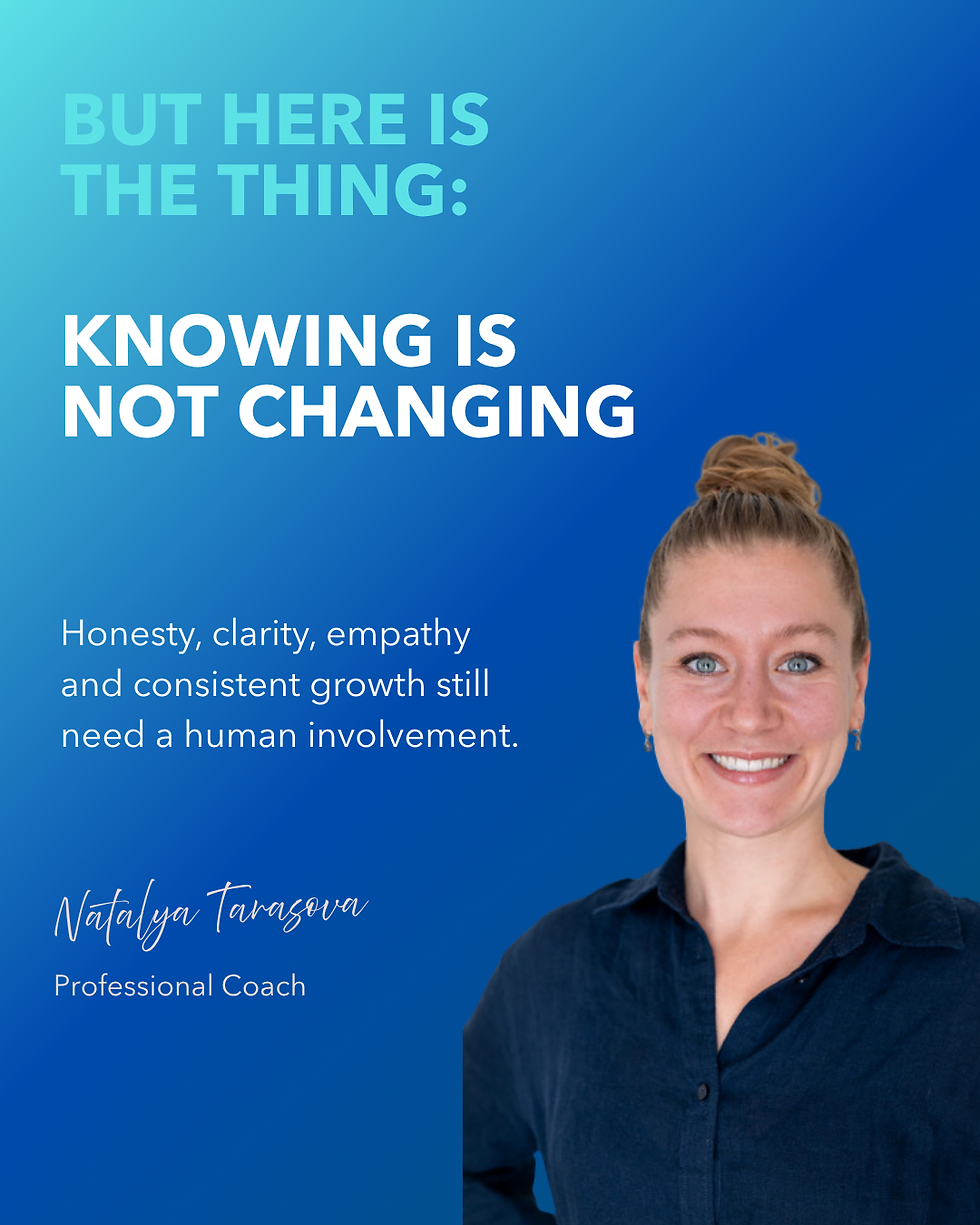
AI can increasingly help people know what to do. The harder problem is helping them actually do it.
The Accountability Gap
Most experienced professionals already know that networking matters. They know they should contact former colleagues, tailor applications, prepare interview examples and negotiate. Information is rarely the entire problem.
Someone can leave an AI conversation with an excellent networking plan and still spend three weeks avoiding the one person they are afraid to contact. That gap between knowing and acting is where human coaching becomes particularly valuable.
A human coach remembers the hesitation from the previous conversation. They can challenge an excuse. They notice that the client has completed nine easy actions while consistently avoiding the uncomfortable tenth. And at the next meeting they can ask a deceptively simple question: "Did you do it?"
THE COACH'S VIEW · Natalya Tarasova
Where do you see the biggest gap between what clients know they should do and what they actually do during a career transition?
They know they need to update their CV, start networking, apply for diverse jobs or explore another career direction. They can get all this information from AI. But having the knowledge doesn't necessarily mean taking the next step. This is often where people come back to a human coach. The gap is no longer knowledge — it is motivation, confidence, making the decision and actually acting on it.

What does human accountability change that an automated reminder doesn't?
AI can remind you what you planned to do. It can give you another prompt or another action plan. But human accountability creates a different kind of commitment. When you know that another person is there, following your progress and expecting you to come back to the conversation, there is an additional motivation to act. A coach can also see when you repeatedly don't do something and start asking why. That is important, because sometimes not taking action is itself information. There may be fear, resistance or another issue behind it. An automated reminder tells you again what to do. A human coach can explore why you are not doing it.
Career coaching is going through its own transition
There is an uncomfortable possibility the coaching profession needs to consider: what if much of what we currently call career coaching moves to AI? Job seekers are already turning to AI to improve CVs, prepare for interviews, analyse vacancies, identify transferable skills and build job-search strategies. If these are the services that define a career coach's proposition, the question is not whether AI will compete with them. It already does.
This creates an interesting paradox. Career coaches spend their professional lives helping people reposition themselves when the market changes. They challenge clients who remain attached to an old title, translate existing experience into new value and help them understand what the market is willing to pay for next. Now the career coaching profession may need to take its own advice.
CV writing, cover letters, generic interview preparation, vacancy analysis, LinkedIn summaries and basic job-search planning are becoming features rather than premium propositions. Coaches don't necessarily need to stop providing them — but they can no longer rely on them to explain why a client should pay for a human.
The commercial question therefore changes from "How do I prove that I can do career coaching better than AI?" to:
"What human problem am I uniquely qualified to solve now that AI can do much of the rest?"
For one practitioner, the answer may be executive career reinvention. For another, rebuilding professional identity after redundancy. Others may specialise in women returning to leadership, senior professionals changing industries, corporate-to-entrepreneurship transitions, confidence and decision-making, or the behavioural barriers that prevent people from acting on what they already know. The more specifically a coach defines the transition they serve, the less directly they compete with a tool that tries to serve everyone.
The irony is difficult to miss: the professionals helping others navigate career transition are now facing a career transition of their own.
Implications for Coaches
Stop selling tasks.
The more clearly a coach understands the transition they are equipped to navigate, the less directly they compete with generic technological advice.
Become better at diagnosis.
If AI handles more of the obvious questions, coaches will need to become sharper at the non-obvious ones — the hesitation, the avoidance, the assumption that has never been examined.
Make thinking visible.
Coaches will increasingly need to demonstrate how they think before clients buy. That is much harder for AI to commoditise — and it is what builds trust before the first session begins.
Use AI themselves.
Rejecting the technology is not a competitive strategy. Coaches who integrate AI into their practice free expensive human time for the conversations that justify it.
THE COACH'S VIEW · Natalya Tarasova
If someone can already access sophisticated AI tools for free, what should they reasonably expect when they decide to pay for a career coach?
Before choosing a coach, I would look at their actual experience, specialisation and ability to understand the market the client is navigating. A strong coach should be able to demonstrate how they work with complex transitions, ask questions that challenge the client's existing assumptions, recognise patterns the client may not see themselves and translate reflection into concrete action. Trust also comes from evidence: relevant professional experience, a clear methodology, client cases and outcomes, and the coach's ability to articulate what they do differently. If I can get generic career advice from AI for free, I need to understand very clearly what paying this particular human will change for me.
If "I am a career coach" is no longer enough to differentiate you, how should coaches market themselves to keep acquiring clients?

I would stop marketing myself as a generic career coach and build the business around a specific transition and a specific client: executives after redundancy, women returning to leadership, professionals changing industries, or corporate leaders moving into entrepreneurship. Then I would build a simple funnel around that expertise: publish a strong point of view on LinkedIn and video, create searchable content that can also be discovered through AI, offer one useful diagnostic or career-transition tool in exchange for contact details, and convert them through a diagnostic conversation rather than a generic free coaching call. Make proof much more visible: real cases, client outcomes, testimonials, methodology and examples of how I think. In 2026, people can get information anywhere. They buy the coach when they recognise themselves in the coach's specialisation, trust their judgment and can see evidence that this person has successfully navigated the problem before.
The Bottom Line
AI has not ended career coaching. It has ended the version of career coaching that was primarily about information delivery — and in doing so, it has clarified what makes the human work genuinely irreplaceable. The capacity to hear what is not being said. To hold someone accountable across the gap between knowing and doing. To question the frame a client brings to the conversation before optimising within it. To recognise the identity question hiding behind the job search request. None of that is something a better prompt will solve. And it is precisely where the expertise clients should still pay for begins — not because human coaches are trying to compete with AI, but because they are finally free to do what they were always best at.
About the Authors
Inna Malaia is the founder of Bevel and works with organisations, teams and professionals on leadership, behavioural patterns and career transition. She is the host of At Work Without Masks, a series exploring what really happens at work beyond titles, egos and corporate narratives.
Natalya Tarasova is a career coach specialising in the technology industry, working individually with professionals navigating complex life and career transitions.
This article developed from a conversation between Inna Malaia and Natalya Tarasova for At Work Without Masks, Careers Episode.


Comments